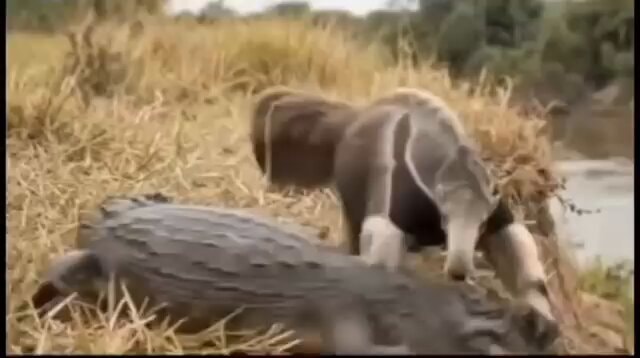
anteater claws vs jaguars
That harmless anteater actually has 4-inch claws capable of scaring off jaguars and caimans. Never underestimate evolution though
النص (en)
In the wetlands of South America, nature rarely follows simple rules. A giant anteater and a chimen collide at the river's edge, a clash of two vastly different evolutionary machines. But how does an animal specialized in eating tiny insects hold its ground against an armored apex predator? The answer lies beneath the surface in biology, anatomy and pure biomechanics. The Pantanal floodplains. Here, waterways serve as feeding grounds and hunting arenas. On land the giant anteater navigates with specialized claw anatomy walking on its knuckles to protect its lethal tools Lurking just beneath the meniscus is the Kyman, a low profile stalker engineered for ambush with exceptional vertical vision and sensitive water displacement detection. Advanced thermal imaging reveals the stark contrast, an endothermic high metabolism mammal glowing against the cool ectothermic signature of the submerged reptile. While the anteater's eyesight is notoriously weak, its sensory adaptation is phenomenal. Specialized nasal passages in the vomeronasal system detect microcurrents and trace chemical compounds carried over the marsh surface it senses danger long before it sees it The Biomechanically, this is an extraordinary matchup. The Kymen features massive pterygoid and adductor jaw musculature, built to snap shut with bone-crushing closing force. Yet the anteater counters with incredible forelimb power. Dense pectorals hyperdeveloped triceps and hooked third digits create an anchor grip that can resist hundreds of pounds of lateral torque The Chiman strikes. Relying on sudden explosive thrust from its laterally compressed tail, it launches from the shallows. But the Anteater doesn't panic. Instead, it employs a classic bipedal defensive stance, locking its recurved claws around the predator's skull. skull. Even underwater, its dense wire-like pellage minimizes bite penetration and reduces friction against the predator's keep. Unable to secure a crushing bite or drown its target, the Chymon disengages. Scanning electron microscopy reveals why the anteater emerges unscathed. Coarse, hollow-form guard hair shed silt, mud, and water instantly. Millions of years of specialized evolution have equipped this peculiar creature not just to survive but to command respect in one of the most perilous ecosystems on Earth.